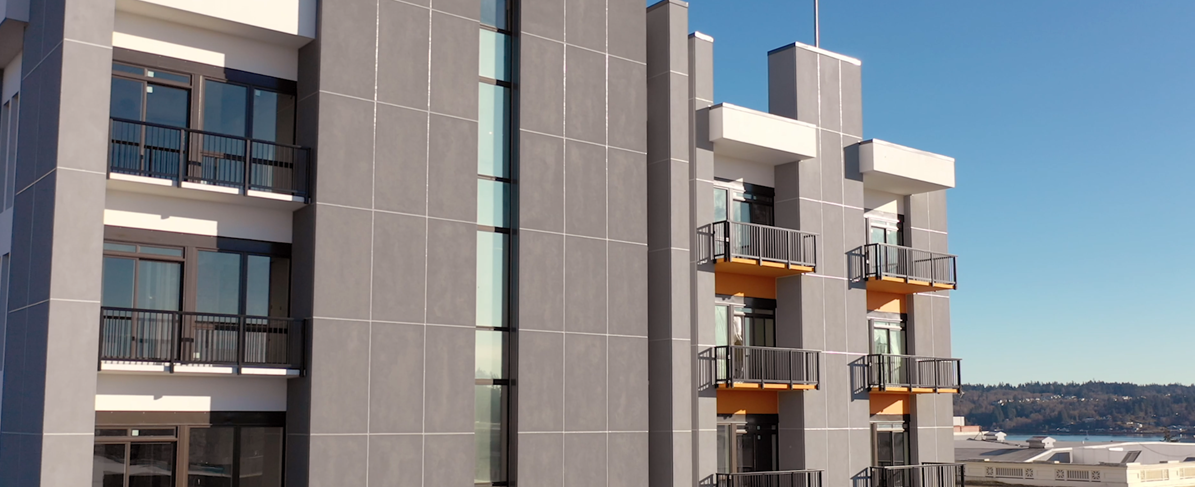
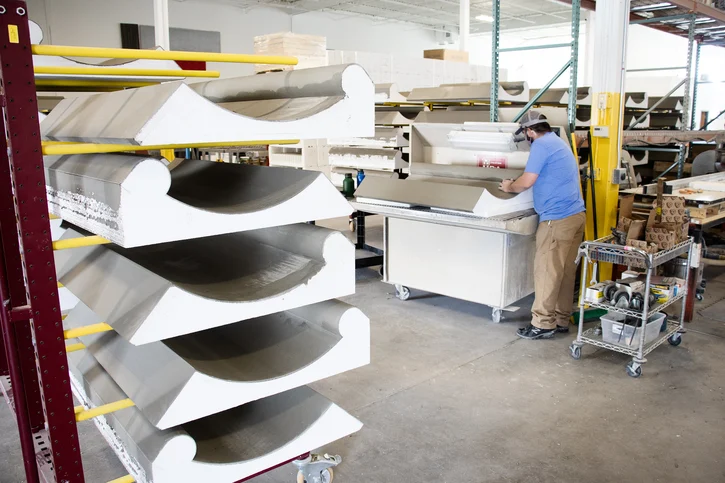
The offsite construction process has several short- and long-term benefits that make it worth considering for building owners, contractors, architects and designers. Compared to traditional on-site building, offsite construction involves segments of a building, from entire rooms to sheathing boards and panels, being assembled indoors in a manufacturing plant and delivered to the job site when ready for installation.
Because a lot of the work has been completed in a factory with climate-controlled settings, labor times are frequently reduced while the level of quality control increases for the overall project. Project timelines are also more flexible and often shortened because manufacturing can be completed anytime of the year without weather delays. But once these components are fabricated and assembled, how do they attach to the building? Let’s dive in to see more about the ins and outs of off-site construction connections and installations.
Offsite construction is common in both new construction and building restorations as contractors look to get the job completed quickly with fewer trades. For existing buildings undergoing renovations, this offsite approach is frequently utilized for restoring the façade with prefabricated exterior wall panels. This overclad or retrofit scenario, when the existing wall stays in tact, is useful for the restoration of hospitals, hotels, office buildings and other multi-use buildings since it minimizes occupant disruption and prevents tenants from having to be displaced during the construction process. It is also easy to match or duplicate the appearance of an existing façade using panelized wall systems.
There are a few important things to consider when connecting modular components:
Like in conventional construction, how building materials interface with each other will be the deciding factor when it comes to specific product selection. Knowing everything you can about the joint size, movement and technology of your materials is critical, especially when it comes to the compatibility and adhesion characteristics.
For example, in a roof-to-wall detail, the asphalt-based roofing product may need to transition to an new panelized EIFS wall assembly. The sealants for the walls may not be compatible with the roof, so an alternative metal flashing may need installed between the two systems. This allows the EIFS to be properly sealed to the flashing and the lower leg of the flashing directs moisture/water away from the backside of the roofing system to the face of the roofing system.
Not using a joint or connector puts your building at an increased risk for water intrusion and detachment of the façade panels or other modular components. Here’s what you need to know about choosing joints and connectors:
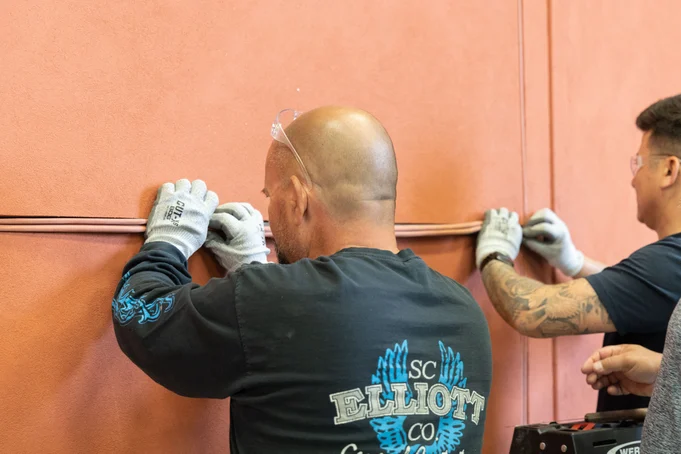
Silicone and urethane sealants are both very popular joint options. Silicone is more expensive than polyurethane sealants, but provides greater movement capabilities. It is also important to note that silicone sealants are not paintable, while urethane sealants are.
Urethanes are often the cheapest option, but they are only guaranteed to withstand certain levels of expansion and contraction.
Pre-compressed, self-expanding foam joint seals, engineered to perform as a weathertight primary seal in various prefabricated applications, are becoming more popular as a replacement for traditional liquid sealants in expansion joints. Their high-movement capability makes them a great solution for panel-to-panel joints on vertical walls.
Additionally, when dealing with larger joint sizes, it may be required to use a foam tape, pre-cured silicone or urethane sheet or a mechanical metal joint. A manufacturer can help identify the best solution depending on the anticipated expansion joint movement.
Choosing the right connectors is dependent on the project and how they are being attached and used. For example, exterior wall panel systems can be adhesively attached or mechanically attached to the wall, but a pre-compressed foam tape may be best to handle the lateral movement between panels. All connectors are typically designed and engineered to exceed maximum loading capacity. As a rule, consider using both primary and secondary joints for additional protection.
Because there are several areas for these modular units that need to connect to make the unit whole, off-site construction often uses more transitions compared to traditional construction methods.
Builders and designers should always review opportunities to improve the building's energy efficiency and reduce its operating costs by examining areas of thermal breaks. While it is hard to eliminate thermal bridging altogether at a transition like the roofline, you can minimize thermal breaks by continuing the insulation above the roofline for the parapet. You can also separate them and add a CI system over the top of the roofline, depending on the roofing system being used. Prefabricated parapet caps are also a great solution for this difficult connection.
To streamline the application of a continuous air barrier, there are gypsum sheathing panels, such as Securock ExoAir 430, available that have a pre-applied air and weather-resistive barrier (WRB) installed and cured in the factory before arriving to the jobsite. This prefabrication eliminates the time-consuming field application of spraying or rolling the liquid air barrier across the face of the entire building envelope. Once onsite, the gypsum boards are attached like traditional sheathing, the seams are detailed with a silicone or urethane sealant, and other connections are made with a compatible liquid or sheet-applied air barrier membrane. More robust exterior wall panels are also available and can even arrive as entire structural wall assemblies with the framing, insulation, moisture drainage and more.
While using prefabrication poses different considerations throughout the design and building process, understanding your product options and the right way to manage connections will ultimately make offsite construction your best choice for a stronger, higher-performing building. By minimizing weather delays and optimizing the consistency of a factory setting, projects will save time and money on the jobsite while increasing overall safety and quality control. To explore the different routes and opportunities in this alternative building method, read our Introductory Guide to Offsite Construction.